A New Niche in SCIF Construction: RF Attenuation of 100 dB
In SCIF construction, RF (Radio Frequency) energy containing sensitive information coming off electronic equipment is an increasing security concern. These RF signals can be picked up and used by adversaries to access otherwise safeguarded information if not blocked properly.
SCIFs are designed to prevent RF eavesdropping and wireless intrusion such as Wi-Fi, cellular, Bluetooth, signals unintentionally radiated by equipment, classified coded information transmissions, and often human speech (think the Situation Room at the White House). Depending on the needs of the facility, it is becoming increasingly important that this classified information cannot be reconstructed or intercepted outside the secure perimeter. If RF signals can escape the room, information might escape too.
What is a baseline level for RF attenuation in SCIFs?
While there is not one perfect number, a common baseline for SCIF RF attenuation is roughly 40-80 dB. But depending on threat levels trying to protect against, and variables like where the SCIF is located, 80-100db is often desired. For example if a SCIF is already located on a secure base, only 40-60 dB would be necessary.
One factor to consider is that each enclosure must be impenetrable and carefully built and maintained. This includes doors, seams, walls, ceilings, HVAC and data paths. A space with “80 dB walls” can perform like a 50 dB enclosure if one penetration is weak or incorrectly welded. Think of a steel bucket full of water. If there is the tiniest hole, water will escape, no matter how strong or expensive the bucket is.
The following gives an idea of RF attenuation ranges:
RF ATTENUATION RANGE: | GENERALLY VIEWED: |
< 40 dB | Not SCIF grade |
~40 – 60 dB | Entry level RF control; suitable in low-threat, controlled surroundings, military protected spaces |
~70-80 dB | Common baseline for many accredited SCIFs |
~90-100 dB | Enhanced / high risk / purpose built environments |
Many factors go into determining how much RF attenuation is enough. First, is the SCIF in a rural or urban location? Distance adds more attenuation. So more distance = less required shielding. Less distance = more required shielding. This is why two SCIFs with identical construction may have different RF requirements.
Second, consider the threat model. Who could intercept, how far, and with what sophistication? A SCIF inside a controlled government building is not the same as one adjacent to a public space. And lastly – consider the equipment inside. Modern electronics emit less RF than older legacy systems.
What’s the big buzz about reaching 100 dB RF attenuation?
So what reaching 100 dB actually means is the RF signal power factor is reduced by a factor of 10¹⁰ (10 billion). 100 dB RF attenuation is a big deal because it marks the point where RF-based espionage becomes physically and operationally impractical—not just difficult—and achieving it requires extreme precision, cost, and discipline.
It represents a high bar that is seldom mandated, difficult to meet, and largely symbolic as a mark of prestige and bragging rights.
How can this be achieved?
Achieving 100 dB of RF attenuation is a complex process guided by standards set by the Intelligence Community Directive (ICD) 705 and NSA 94-106. It requires specialized design and materials such as:
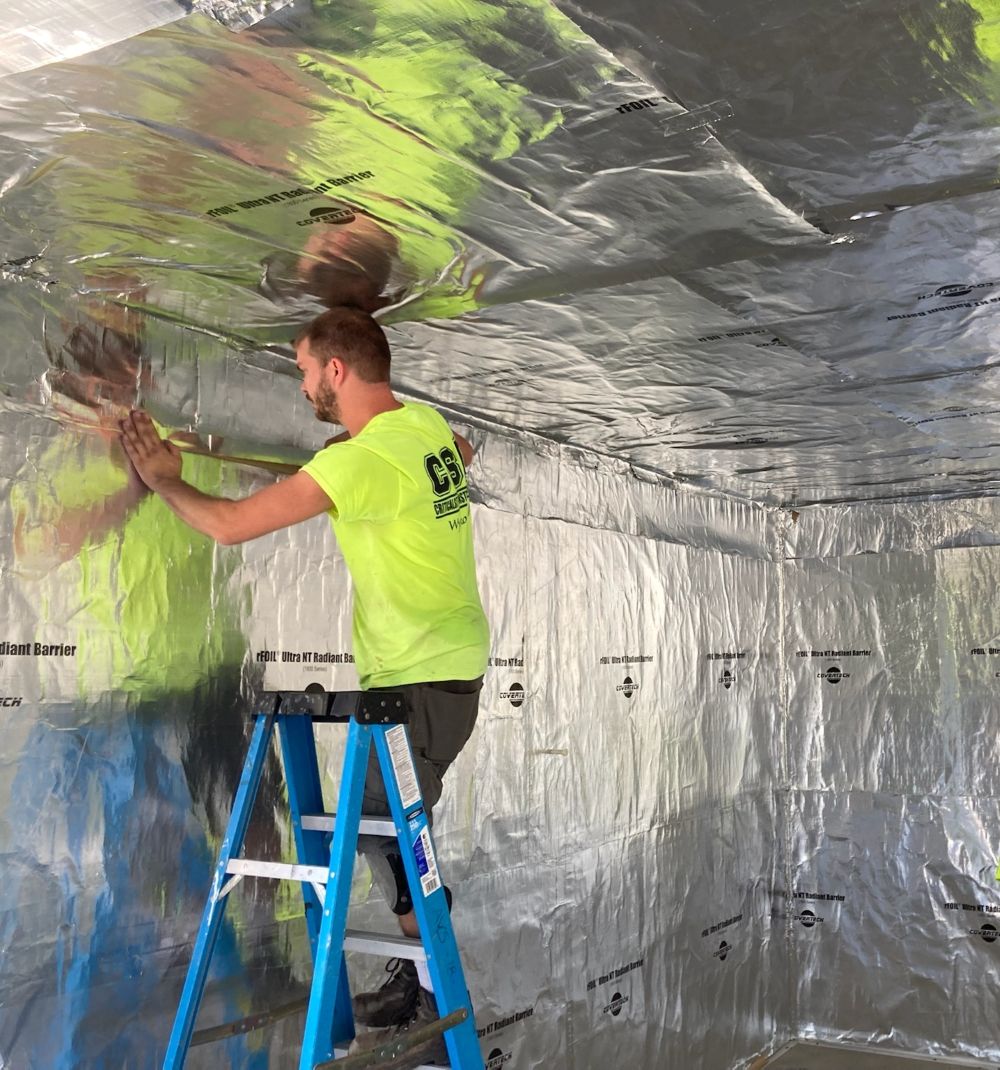
- Six-sided enclosure: (all walls, floor and ceiling) using continuously welded steel plates or other high performing shielding materials
- RF shielded doors: specialized doors with full perimeter drop seals that border all sides
- Mitigation of penetrations: every penetration (electrical boxes, conduits, pipes, etc.) must be carefully treated and sealed with acoustic/RF sealants and proper filtration systems to ensure the shielding integrity is not compromised
- Accredited testing: The facility must undergo comprehensive performance tests by a certified professional to confirm it meets or exceeds the specified attenuation levels
What are the challenges of reaching 100 dB attenuation?
The part that people underestimate is that RF leakage doesn’t behave like light or sound. It finds seams, couples into cables, leaks through tiny gaps, reradiates off metal, and sneaks through HVAC, power, and grounding paths. So at:
40-60 dB, you’re blocking most energy
80 dB, you’re blocking almost almost ALL energy
100 dB, you’re fighting door gaskets, fasteners, paint continuity, microscopic cracks, bonding resistance, every penetration detail.
At that point, construction tolerances become security vulnerabilities.
Costs and complexity also explode near 100dB. Going from 60-80dB is manageable. 80-90dB is expensive. But 90-100 can be painful. You’re talking about fully welded or soldered RF enclosures. Continuous conductive materials with no shortcuts. Custom shielded doors, which can often be the weakest link. Meticulous grounding and bonding, and zero casual penetrations. Also consider if you’re doing a small government safe room vs an industrial size modular SCIF. This is why SCIFs don’t actually need or require 100db, but may just want to be considered in niche situations.
Finally, it is hard to measure and prove 100 dB reliably. Because at 100 dB attenuation, the signal is so weak that it’s often buried under background noise and the limits of the test equipment (you may be fighting with power supplies injecting noise) making it hard to tell whether the signal is truly blocked or just impossible to measure accurately. Because at 100 dB RF attenuation, you’re trying to measure something that’s right at – or below – the limits of both physics and test equipment. Past a certain point, the problem stops being “how much leaks out” and becomes “can we even prove it didn’t?” Certification must then focus on risk reduction, not perfect measurement.
Critical Site Construction (CSC): Expertise in Mission-Critical Secure Facilities
Critical Site Construction (CSC) is uniquely positioned to achieve RF attenuation approaching 100 dB. As a deeply trusted and highly reliable partner of the United States Department of Defense (DoD), our core expertise lies in the precise construction and rigorous certification of SCIF facilities, ensuring they meet the stringent security and technical requirements demanded by the DoD and other federal agencies. Along with US government agencies, CSC also partners with foreign governments, and private clients, and is a specialized provider for achieving high level RF attenuation.
Whether it’s a mission-specific government facility designed from the ground up, a mobile SCIF outside a major city, or building within existing parameters, CSC has over 25 years in the specialized domain of mission-critical construction, and possesses an unparalleled depth of knowledge and technical acumen. This extensive history is vital when constructing SCIF structures with highly specific RF attenuation and electromagnetic shielding requirements necessary for protecting classified information.
CSC is both a construction firm and comprehensive turnkey provider, specializing in design consultation, and technical and material specification on each project, including RF shielding, STC doors, acoustic barriers, and access control systems. Employees are specialized, cleared personnel, and work with proven methodologies to execute the construction with meticulous adherence to technical drawings and security protocols. CSC engages in rigorous final testing procedures, RF attenuation testing (TEMPEST), to confirm the structure meets or exceeds all specified performance parameters and is ready for accreditation.
CSC is committed to provide a final product that not only meets but surpasses the stringent security and operational expectations of our government, military, and private partners. If the new benchmark is coming closer to 100 dB of RF attenuation, no one is better positioned to assist than Critical Site Construction.
Ratha McCann is a freelance writer for tech/engineering/construction, news, entertainment, streaming content, podcasts/apps, She can be reached at rathamccann@yahoo.com.