SCIF: Conventional Construction vs. Modular Construction: Which is Right for You?
Many mission critical installation projects, whether for government, military, corporate or private business, face several important choices on how to keep their data safe and their facilities secure. Recently, the decision between outfitting an existing space into a conventional SCIF or constructing a modular SCIF has become an increasingly interesting topic of discussion.
A Sensitive Compartmentalized Information Facility, otherwise known as a SCIF, is a facility either built within an existing structure or from the ground up on location. Every dimension, material, penetration, and access point is governed by detailed technical criteria to receive accreditation. SCIFs are accredited by the Director of National Intelligence (DNI) which issues ICD 705 (Intelligence Community Directive 705) and details the requirements a SCIF must meet such as wall construction, floor and ceiling standards, window and door security, HVAC, acoustic, and RF shielding requirements. Once accredited, classified work can begin inside.
Depending on the level of security for SCIF projects, there may be TEMPEST requirements (a government authority that evaluates classified facilities and determines what RF/electromagnetic protections are needed). These requirements can measure how much RF energy leaks out of a space, the acoustic shielding effectiveness expressed in dB or decibel attenuation, and evaluates what level is needed to keep these signals secure. The degree of TEMPEST protections vary based on each project, and are not generally required for commercial or non-classified RF shielding jobs.
What is a Conventional Constructed SCIF?
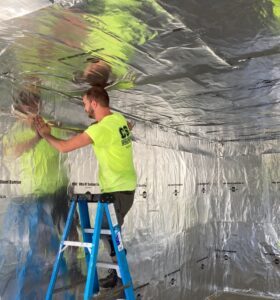
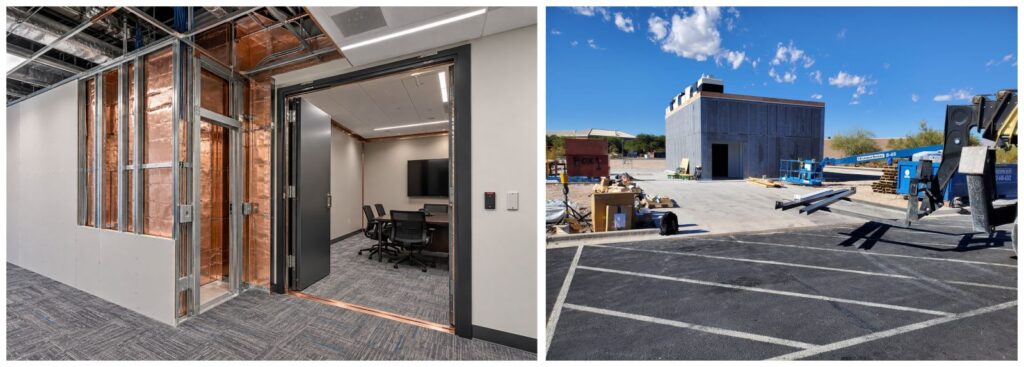
A conventional SCIF is built within an existing structure. To ensure security, materials such as RF shielding are installed within the walls of the room. RF Shielding is designed to reduce the RF (radio-frequency) and electromagnetic signals passing into or out of a space. It uses conductive materials like copper, steel, or specialized foil to create a continuous barrier across walls, floors, ceilings, and penetrations, helping block unwanted RF and electromagnetic signals. Think of a classified meeting of military advisors on a military base discussing upcoming operations. Or a private cell phone call in a secure conference room between university researchers and private industry. Or the Situation Room at the White House. Or an additional layer of protection desired by a Data Center to reduce electromagnetic interference. Or an air traffic control tower, to shield their flight tracking software from incoming radio frequencies or malicious interference. RF shielding is one of many materials installed into the space along with STC doors, duct silencers, waveguides and various sealing techniques to ensure electromagnetic and sound waves are blocked.
What is a Modular SCIF?
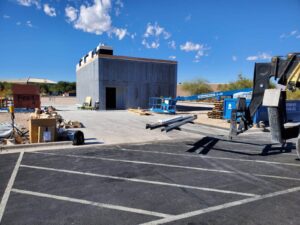
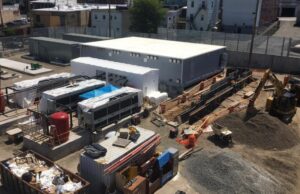
A modular SCIF is a prefabricated facility assembled on site. A modular SCIF consists of prefabricated modular panels that are assembled on location either as a stand alone structure or within a larger section of a pre-existing building. Modular SCIF panels achieve near-indestructible status by using a layered composite matrix of heavy-duty materials engineered to defeat simultaneous physical, ballistic, blast, acoustic, and electronic threats. Then, this modular SCIF can be moved anywhere. Think of dropping a secure box into the middle of a military base.
Who are potential clients of these Sensitive Compartmented Information Facilities?
Organizations seeking ways to protect highly sensitive information and secure facilities, include government agencies, military bases, defense contractors, technology and cybersecurity companies, data centers, research organizations, universities, air traffic control server rooms/ airport, and other private-sector entities and businesses.
The strongest overlapping market is organizations that process classified information and need both secure physical constructions, and protection against compromising electromagnetic emissions.
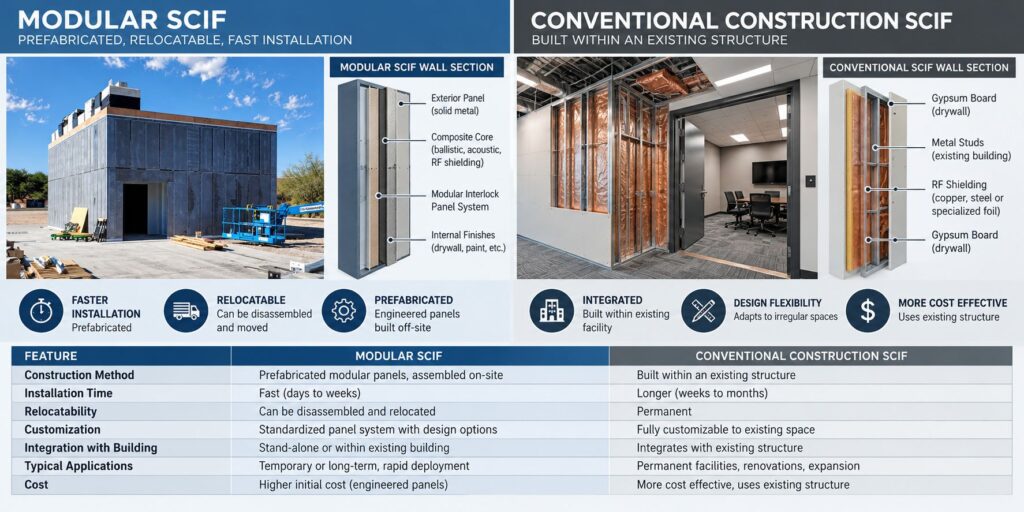
Top 5 Reasons Conventional SCIF Construction is Right for You:
- Existing ground-up structure already intact: In certain cases it may not be practical to build a new structure, and it may be a better decision to foil and secure existing. A large military base, data center, or medical facility may benefit from simply adding the security of RF shielding, waveguides, STC rated doors and other secure materials to an already existing infrastructure.
- More cost effective: By simply adding RF shielding, STC doors and acoustical materials to a pre-existing space, a conventional SCIF may be a fraction of the price of building a new modular SCIF from scratch. This is because the structure being secured is already an existing structure, and it does not involve the cost of highly engineered panels on a new construction.
- Primary goal is protecting against espionage as opposed to physical security: If the main concern is protecting sensitive information from surveillance, electronic compromise, or interception coming into or out of your secure facility – then conventional SCIF construction with continuous RF shielding is the way to go.
- Highly adaptable and can fit into irregular or tight office spaces: RF shielding and related materials are highly adaptable, ranging from solid metals, to metalized fabrics and foils, to metal plated paints and coatings. This allows the shielding to easily wrap around existing pillars and walls, seal penetration points, and fit to irregular room shapes.
- AI Data Centers, air traffic control centers, and other rapidly expanding needs require fast, effective protection: These industries are rapidly growing, and operate with zero tolerance for data corruption or signal loss. Conventional SCIF construction is a solution to protect ultra high-speed data from corruption (data centers), and prevent radio blind spots, tracking drops, and interference (airports).
Top 5 Reasons a Modular SCIF is Right for You:
- High level of security against physical threats: While conventional SCIF construction using continuous RF shielding materials protects signals, a modular SCIF shell protects the entire physical boundary. Built to survive extreme conditions, modular SCIFs panels are engineered to withstand bombing and ballistic threats, explosive blasts, as well as severe weather events like hurricanes, tornadoes and natural disasters.
- Better Quality Control: The engineered panels in Modular SCIF’s are factory built, exhibiting consistent quality control; every panel meets exact specifications without the field variability and human error common on active construction sites. Radio frequency (RF) shielding, sound-proofing (such as STC-rated acoustic performance), and physical security elements are engineered directly into the panel’s core during fabrication to attain a high level of acoustic blockage. This prevents sound from escaping ranging from spoken conversations to incredibly loud machinery or engines. Attenuation of 100db can be achieved in elite SCIF builds. However keep in mind these could be very large builds, easily weighing several tons.
- Modular SCIFs can be easily built and moved anywhere: A modular SCIF can be built off-site, which may be more convenient for some organizations, and moved in modular pieces to location. This may be less disruptive than starting new construction in a current high traffic location.
- Modular SCIF construction can be quicker: Because a modular SCIF can be built turnkey at a separate location, these builds tend to be much quicker than a conventional SCIF build. Generally speaking, a 1000 sq. ft. build can take 6-8 weeks. Because all factors are controlled at a separate location – that means less security clearance with outside contractors needing vetting to enter secure facilities (construction, HVAC, plumbers, carpentry) which can often hold up jobs.
- You need a stand-alone building: If the goal is complete control over the process from start to finish, elimination of any vulnerabilities of shared office walls, floors, utility ducts, and floor to ceiling boundaries, then a modular SCIF might be what your project is looking for.

Looking to Build a SCIF Facility?
At Critical Site Construction (CSC) we engineer custom security solutions for mission-critical projects. A registered Department of Defense contractor, we provide military and private clients with advanced SCIF construction. Whether you are looking for a team to install RF shielding, STC doors and various acoustical elements into a conventional build, or assemble a modular SCIF on-site, Critical Site Construction can help take your project to the finish line.
Critical Site Construction is proud to partner with multiple mission critical suppliers to offer both Material and Labor for all of your mission critical projects.
We work with the US government as well as private companies such as those involved in technology or research, to secure sensitive information for mission-critical environments. With a proven track record of building facilities that pass federal inspections under ICD 705, and that meet TEMPEST requirements, we build unparalleled protection that slows down adversaries before a breach can actually occur.
Critical Site Construction can work with you from start to finish and offers turnkey service: from initial design and planning, to personnel clearances, construction, installation, accreditation and final project completion. At CSC, we bridge the gap between blueprint and reality. We ensure your strategy is flawless on paper, buildable in the field, structured for trouble-free testing, and built for decades of reliable performance. Reach out today for your next mission critical install.
Ratha McCann is a freelance writer for news, entertainment, streaming content, podcasts/apps, and has most recently delved into tech/engineering/construction. She can be reached at rathamccann@yahoo.com.